Elliewood Avenue
Charlotte Oleson / VMag at UVA
More than Just Coffee and Bars: The Past and Present of Elliewood Avenue.
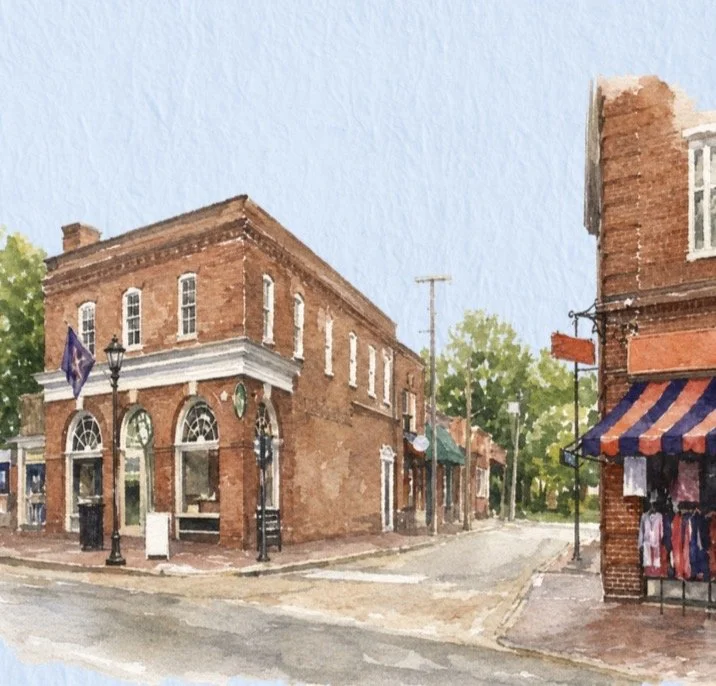
Over the past century, Elliewood Avenue — a seemingly quaint dead-end road off University Avenue — has undergone transformations that could make it almost unrecognizable to alumni and Charlottesville natives alike. From residential buildings to businesses and University offices, Elliewood’s historic brick facades have been a home to many over the course of their storied past.
So, how did Elliewood Avenue become the road we know it as today? According to Olivia Brown, Executive Director of the Albemarle Charlottesville Historical Society, the story of the road begins in the early 20th century.
“When you look at that early period of Elliewood Avenue, the 1910s, the 1920s and a little bit after that as well, it's mostly residential, and it's a lot of boarding houses or rooming houses,” Brown said. “U.Va. students would rent the rooms from [the proprietors]. It was pretty much like apartment complexes.”
One such proprietor was Ellie Mason Page. It was her daughter, Ellie Wood Page, who the road would come to be named after.
According to Brown, Page viewed the students who rented her mother’s house out as something like older brothers. And their affection for her is no question — because it was the road she always played in, the tenants put up a cardboard sign effectively dubbing their road “Ellie Wood Avenue.”
“Ellie Page, the mother who owned the boarding house, took it down,” Brown said. “She didn't like it.”
A back and forth battle ensued between Ellie Mason Page and her tenants, who refused to take down the sign. The struggle would only come to an end when the city of Charlottesville asked her to leave it up after city residents began referring to it as Elliewood Avenue in earnest.
For the next few decades, Elliewood Avenue remained a street dominated by residential buildings. It was not until the 1970s that the street gained commercial success following an increase of vacant lots beginning 20 years prior.
In that regard, the 1970s gave rise to parts of the Elliewood Avenue we know to- day. It was then that staples on the street, including Heartwood Books, took hold and solidified the area as a bona fide shopping district.
By the time Mark Lorenzoni, founder of Ragged Mountain Running Shop, arrived at Elliewood Avenue in 1981, the road had transformed to be entirely filled with small, unique shops.
“[Elliewood Avenue] was a thriving retail street,” Lorenzoni said. “There was a bicycle shop, there was a hiking store, there were two bookstores, there were a couple of salons, there was a shoe store to buy regular shoes — I mean, it was just abuzz with retail.”
The Elliewood Avenue that Lorenzoni describes contrasts to the road students are greeted with today: retail has been almost entirely replaced by bars, restaurants and similar enterprises.
According to Lorenzoni, this shift did not happen overnight, and it is not a phenomenon unique to the University.
“Most of these university shopping districts around the country, they have gone to food and beverage because retail hasn't been able to make it,” Lorenzoni said. “We've been lucky, because our base [of] customers are locals or people that travel to see us.”
Lorenzoni went on to describe that without such strong customer bases, other businesses on Elliewood have failed or been forced to change locations due to low interest from University students and a resulting lack of foot traffic. That certainly is not to say the businesses on Elliewood play no long-lasting role in the lives of students today though.
Student employees on Elliewood Avenue get a unique glimpse into the community occupying the short stretch of asphalt according to fourth-year College and Commerce student Diya Gupta. As an employee at Coupe’s located right in the middle of the street, she has been able to build connections with others working on and around Elliewood.
“As a first-year [or] second-year, these bars seem really daunting and big, and all the restaurants seem like big corporations,” Gupta said. “But I think that working there kind of humanizes the perspective. You're friends with the managers and you're friends with the people that you're working with, and maybe a bartender isn't so scary after all.”
Gupta went on to describe how the road has a distinct “homey” vibe that the rest of the Corner just can not offer — big names like Chipotle and the seemingly omnipresent 7 Day Junior do not carry the same welcoming energy. When you walk down Elliewood Avenue, you know you will find people chatting at the tables outside of Take It Away Sandwich Shop, sipping a drink with a friend at Grit Coffee and wandering through the narrow walkways of Ginkgo Bookshop. It is a place where students can find and create community.
Whether it be the students who lived there a century ago or the employees work- ing there today, it seems that Elliewood Avenue has always been a place that welcomes community and interaction. Change on Elliewood is inevitable, but one thing is for certain — it will always be more than just a road.